Rust · Permits · Weather · Cost
Nicholasville Metal Roof Coating Questions
Answers to what owners ask about coating commercial metal roofs in Nicholasville, Wilmore, and Lancaster, from rust and screws to permits and timing.
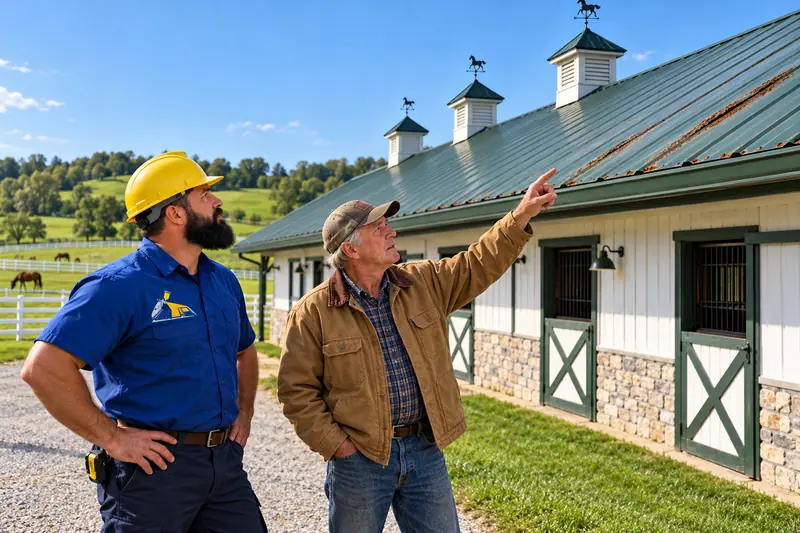
Metal roof coating is a liquid-applied film, built up in coats on cleaned steel roof panels, that waterproofs fasteners, seams and laps and stops rust from spreading.
Nicholasville Metal Roof Coating coats commercial metal roofs and applies silicone, acrylic, spray foam and shingle roof coatings on business, industrial and farm buildings in Nicholasville, Jessamine County, Kentucky, and nearby Wilmore and Lancaster.
Answers By Topic
Jump to a topic, or read straight through. Each answer comes from the questions owners ask us most.
- Metal Roof Coating Basics
- Rust, Fasteners and Seams
- Choosing a Coating System
- Climate and Weather Around Nicholasville
- Prep, Application and Downtime
- Cost, Value and Taxes
- Permits, Codes and Utilities
- Questions by Town
- Getting Started
Metal Roof Coating Basics
What Does a Metal Roof Coating Actually Do on a Commercial Building?
Coating a metal roof forms a continuous rubbery skin over the panels, so water can no longer reach the screw holes, panel laps and seams where leaks on metal roofs start. The coating bridges small gaps that open as steel expands in summer heat and shrinks on cold nights.
A typical system goes on in three layers:
- Rust-inhibiting primer on cleaned steel and fastener heads.
- Reinforced sealant or fabric over every lap, seam and penetration.
- Field coats across the full panel surface, built to a set dry thickness.
A white or light topcoat also reflects sunlight that a bare galvanized or faded painted panel would absorb.
Which Commercial Metal Roofs Are Good Candidates for Coating?
Metal roofs with surface rust, loose or backed-out screws, and leaking laps are the best candidates, as long as the steel underneath keeps its full thickness. Pressing on rusted areas tells a lot: firm panels can be coated, while flaking or perforated panels need replacement first.
Good candidates in central Kentucky include:
- Warehouses and shop buildings with exposed-fastener R-panel.
- Churches and offices with older standing seam that leaks at end laps or trim.
- Barns, equipment sheds and ag buildings with chalky painted panels.
- Strip centers with low-slope metal behind a parapet.
Roofs with holes rusted through, sagging purlins or panels that flex underfoot need structural work before any coating goes on.
How Is Coating a Metal Roof Different From Painting It?
Paint is a thin film meant for color and light corrosion protection, while a roof coating goes on many times thicker and stays flexible enough to bridge seams and fastener holes. Field paint on a roof tends to crack at the laps because steel panels move every day.
| Feature | Exterior paint | Elastomeric roof coating |
|---|---|---|
| Thickness | Thin film | Many times thicker, measured in mils of dry film |
| Seam and lap sealing | None | Reinforced at every lap and seam |
| Stretch | Low | High, moves with the panels |
| Fastener treatment | Covers screw heads only | Seals washers and screw holes |
| Reflectivity | Set by the color | Light colors rated for solar reflectance |
Does a Coating Add Weight or Change How the Roof Drains?
The added weight is small, because a coating is a thin liquid-applied membrane rather than new panels or insulation board. Most metal roofs and their purlins carry it without any structural change.
Drainage stays the same on a pitched metal roof, since water still runs down the panel ribs to the eave and gutter. Two spots deserve a closer look:
- Low-slope metal behind parapets, where ponding at end laps leaves dirt rings and wears the coating faster.
- Gutters and downspouts packed with rust scale or leaves, which back water up under the eave trim.
Crews clean the gutters and keep coating build-up at the eave from closing off the drip edge.
Rust, Fasteners and Seams
Can You Coat Over a Rusty Metal Roof?
Surface rust can be coated after it is cleaned and primed, but steel that has rusted through needs patching or panel replacement first. The difference shows up when a crew scrapes and probes the worst spots on the roof.
| Rust condition | What you see | Usual treatment |
|---|---|---|
| White rust | Chalky white powder on galvanized or Galvalume panels | Wash, then apply a primer rated for galvanized steel |
| Light red rust | Orange staining and rust bloom on the surface | Wire brush or power tool cleaning, rust-inhibiting primer |
| Heavy scale | Flaking layers and pitting at laps and screws | Remove scale to firm steel, prime, reinforce |
| Perforation | Pinholes or holes that show daylight from inside | Patch with new metal or replace the panel |
Rust tends to start at panel laps, cut edges and the fastener line, where water sits longest.
What Happens to the Screws and Washers When a Metal Roof Is Coated?
Every exposed screw gets checked, tightened or replaced, then sealed under the coating, because fasteners are the most common leak point on an exposed-fastener roof. Rubber washers under the screw heads dry out and crack in the sun, and daily panel movement slowly backs screws out of the purlins.
Fastener work on a coating job covers:
- Driving down loose screws that have lifted off the panel.
- Swapping stripped or rusted screws for oversized replacements.
- Capping each screw head with sealant or brush-grade coating.
- Plugging old empty screw holes left from earlier repairs.
On a big warehouse roof this step can mean thousands of fasteners, so it drives a large share of the labor.
How Are Panel Laps, End Laps and Seams Sealed?
Laps and seams get a reinforced detail, usually a band of polyester fabric or seam tape set in coating, before any field coat goes on. These joints open and close with temperature, so they need a thicker, stronger layer than the flat of the panel.
The crew works in this order:
- Clean the lap and pull out old caulk that has dried and separated.
- Prime any rust at the overlap.
- Embed fabric or tape over side laps and end laps, then brush coating through it.
- Treat ridge cap, eave trim and rake trim joints the same way.
End laps on long panel runs carry the most water and the most movement, so they get the closest look on low-slope buildings.
Can Leaking Skylight Panels, Ridge Caps and Curbs Be Fixed in the Same Job?
Skylight panels, ridge caps, pipe boots and HVAC curbs are sealed as part of the coating work, since leaks at these details are often why owners call in the first place. Each one gets cleaned, reinforced and coated so it ties into the field coating.
| Detail | Common problem | Fix during coating |
|---|---|---|
| Fiberglass skylight panels | Yellowed, brittle, cracked at fasteners | Replace brittle panels; coating over them blocks daylight |
| Ridge caps | Loose foam closures, backed-out screws | Re-fasten, seal closures, fabric over cap laps |
| Pipe penetrations | Cracked rubber boots | New boot or a fabric and coating wrap |
| HVAC curbs | Rust and open seams at the curb flashing | Clean, prime and reinforce the curb base |
What Is the Difference Between Standing Seam and Exposed-Fastener Roofs for Coating?
Exposed-fastener R-panel roofs need the most prep because every screw is a potential leak, while standing seam roofs hide their clips and leak mostly at end laps, trim and penetrations. The coating system is similar, but the labor lands in different places.
| Prep item | Exposed-fastener (R-panel, PBR) | Standing seam |
|---|---|---|
| Fasteners | Check, replace and seal each one | Few exposed, mostly at trim |
| Side laps | Fabric or tape along every lap | Raised seams; check for open seams and clip movement |
| End laps | Reinforce | Reinforce and watch for ponding on low slopes |
| Field coating | Full coverage | Full coverage, extra care on seam tops |
| Main leak points | Screws, laps, curbs | End laps, ridge, penetrations, eave trim |
Standing seam panels are built to slide on their clips, so the coating over the seam has to stay flexible.
Choosing a Coating System
Silicone or Acrylic: Which Coating Is Better for a Metal Roof?
Silicone holds up better where water sits, and acrylic is a strong choice on steeper metal roofs that shed water quickly. Both go on as a white, reflective topcoat over primed steel.
| Factor | Silicone | Acrylic | Urethane coatings |
|---|---|---|---|
| Ponding water | Resists it well | Softens under standing water | Resists it well |
| Foot traffic and impact | Moderate | Moderate | High |
| Dirt pickup | Collects more dirt over time | Stays cleaner | Moderate |
| Recoating later | Silicone over silicone | Bonds to many coatings | Check compatibility |
| Best fit on metal | Low-slope metal, end laps | Pitched exposed-fastener roofs | Base coats and high-traffic areas |
Slope, end lap condition and rooftop traffic decide the pick on most metal buildings.
Can Spray Foam Be Installed Over a Metal Roof?
Spray polyurethane foam can be sprayed directly over a metal roof to fill the panel ribs, add insulation and create a new continuous surface, then topped with a protective coating. Closed-cell roofing foam runs about R-6 per inch according to the DOE Building America spray foam guide, so it fits buildings that need insulation along with leak repair.
| Factor | Coating only | Spray foam plus coating |
|---|---|---|
| Insulation added | Minimal | Significant, closed-cell foam |
| Panel ribs | Coated, profile stays | Filled to a smooth surface |
| Ponding on low slopes | Coating must resist it | Foam can be tapered toward gutters and drains |
| Rooftop work time | Shorter | Longer and more weather-sensitive |
| Best fit | Solid panels leaking at seams and screws | Heated or cooled buildings that need insulation |
Can You Coat an Asphalt Shingle Roof on a Commercial Building?
Some asphalt shingle roofs on offices, churches and strip centers can be coated, but only when the shingles still lie flat and the coating maker approves its product for shingles. Shingle coatings extend a roof in fair condition, and they will not fix curled, missing or granule-bare shingles.
Before coating shingles, check:
- Tabs for curling, cracking or wind damage.
- Valleys and step flashing, where water concentrates.
- Attic or plenum ventilation, since a coating changes how shingles release moisture.
- Manufacturer terms for the shingles, which a coating can affect.
Where shingles have failed, replacement is the right call.
Do White Roof Coatings Really Keep a Metal Building Cooler?
A white coating reflects more sunlight than bare or faded metal, which lowers roof surface temperature and cuts heat flowing into the space under the deck. The U.S. Department of Energy guide to cool roofs rates coolness with two numbers, solar reflectance and thermal emittance, each on a 0 to 1 scale where higher means cooler.
Points to keep in mind:
- Cooling savings show up most in buildings that run air conditioning under the roof.
- Unconditioned barns and storage sheds gain comfort more than utility savings.
- Reflectivity drops as dirt collects, so washing helps hold performance.
- Winter heating needs can rise under a cool roof, a tradeoff DOE notes for mixed climates.
Rated products are listed in the Cool Roof Rating Council directory and on ENERGY STAR's cool roofs page.
Can a Metal Roof Be Coated if It Was Coated Before?
Previously coated metal roofs can be recoated once the old coating passes an adhesion test and any peeling or blistered areas are removed. The existing coating type matters most, because new material has to bond to what is already there.
A recoat check looks at:
- Adhesion, using a small pull-test patch on the old coating.
- Chalking, a powdery film that has to be washed off.
- Blisters and peeling around screws and laps, where water got under the old layer.
- Type of existing coating, since silicone usually accepts only more silicone.
Bare spots where old coating has worn through to rust need full rust prep before the new coat goes on.
Climate and Weather Around Nicholasville
How Does Central Kentucky Weather Affect a Metal Roof?
Central Kentucky's wet years and sharp temperature swings work metal roofs hard, opening laps and loosening screws as steel heats and cools. NWS Louisville, the forecast office covering the Lexington area just north of Nicholasville, recorded 49.98 inches of precipitation at Lexington in 2024, close to normal, in its 2024 annual climate summary.
That same year brought a low of minus 7 degrees on January 21, then a 64 degree high four days later. Swings like that move panels back and forth on their fasteners, and each cycle wears on washers and lap sealant. A coating with good stretch in cold weather keeps those joints closed through winter.
Is Hail Damage on a Metal Roof a Reason to Coat or Replace?
Cosmetic hail dents alone rarely call for new panels, and a coating can go over dented steel as long as the panel finish and seams are intact. Trouble starts when hail cracks the paint at the dent, splits seams, or breaks fiberglass skylight panels.
After a spring storm, look for:
- Paint cracked at dents, which opens the steel to rust.
- Broken skylight panels and dented ridge caps.
- Gutters bent or pulled loose at the hangers.
- Debris piled against curbs and in valleys.
Photograph damage before any repairs. Coverage questions belong with the policy and the adjuster, and a coating crew documents what it finds on the roof.
When Is the Best Time of Year to Coat a Metal Roof in Kentucky?
Late spring through early fall gives the most dependable coating weather around Nicholasville, because coatings need dry panels and mild temperatures to cure. Morning dew, rain in the forecast and cold nights all shorten the working day.
| Season | Coating conditions | Watch for |
|---|---|---|
| Spring | Good once nights warm up | Storm days, wet mornings |
| Summer | Long dry days | Very hot panels, afternoon storms |
| Fall | Often ideal | Early sunset, heavy dew, leaves in gutters |
| Winter | Limited | Cold steel, frost on panels, slow cure |
Each product lists minimum air and surface temperatures. Crews check the steel itself with a surface thermometer, since panel temperature can sit far from air temperature on a sunny or frosty morning.
Question About Your Own Roof?
Call and describe the building and what you are seeing. We will answer it, or set up a roof walk if the roof needs one.
Prep, Application and Downtime
What Prep Work Does a Metal Roof Need Before Coating?
Cleaning is the most important step, since coatings bond only to steel that is free of dirt, chalk, oil and loose rust. Most metal roof jobs begin with a pressure wash and a cleaner matched to the existing finish.
Prep covers:
- Washing panels, gutters and trim to remove dirt, chalk and mildew.
- Scraping and brushing rust at laps, screws and cut edges.
- Replacing rusted-through panels and broken skylight panels.
- Fastener work on every exposed screw.
- Masking rooftop units, vents and anything that should stay uncoated.
A small adhesion test on the cleaned surface confirms the primer and coating will hold before the whole roof is coated.
How Is a Metal Roof Coating Applied?
Crews apply metal roof coatings by spray or roller in stages: primer, seam and fastener details, then one or two full field coats. Each stage cures before the next goes on.
- Prime rusted areas, or the full roof when the panel finish calls for it.
- Detail laps, seams, screws, curbs and ridge caps with reinforced coating.
- Spray or roll the base coat across the panels.
- Finish with a topcoat in the specified color.
- Gauge the dry film thickness and touch up thin spots.
Airless spray fits large, open warehouse roofs, while rollers and brushes give more control near rooftop units, gutters and skylights where overspray is a concern.
Can a Business Stay Open While the Roof Is Being Coated?
Most businesses keep operating during a metal roof coating job, because the work happens on top of the panels and nothing gets torn off. The main interruptions come from overspray control, rooftop unit shutdowns and parking near the work area.
Plan for:
- Short HVAC shutdowns while coating goes on near air intakes, so odors stay outside.
- Coned-off zones under the eaves where equipment and hoses set up.
- Car and truck parking moved away from spray areas on windy days.
- Ladder or lift access points agreed with the building manager.
Warehouses with dock doors often rotate which doors stay open as the crew moves across the roof.
How Long Does It Take to Coat a Commercial Metal Roof?
Job length comes down to roof size, the amount of rust and fastener work, and the weather window. A small office roof with clean panels moves quickly, while a large warehouse with heavy rust and dozens of curbs and skylight panels takes much longer.
| Factor | Speeds the job | Slows the job |
|---|---|---|
| Rust | Light surface rust | Heavy scale, panel replacements |
| Fasteners | Mostly tight | Many backed-out or stripped screws |
| Details | Few curbs and skylights | Many penetrations and skylight panels |
| Access | Open lot, easy lift setup | Tight sites, busy loading docks |
| Weather | Dry, mild stretch | Rain, dew, cold nights |
Ask for a schedule that shows prep days apart from coating days, since cure time between coats sets the pace.
Cost, Value and Taxes
What Affects the Cost of Coating a Metal Roof?
The biggest cost drivers on a metal roof coating are the square footage, how far the rust has gone, and how many fasteners need attention. Two buildings with the same square footage can price very differently when one needs a wash and the other needs panel replacement and thousands of new screws.
Main cost drivers:
- Square footage and roof slope.
- Amount of rust treatment and primer.
- Fastener replacement and lap reinforcement footage.
- Number of skylight panels, curbs, vents and ridge cap runs.
- Coating type and total film thickness.
- Lift access, staging and site restrictions.
A roof inspection with photos and measurements pins these down for a specific building.
Is Coating a Metal Roof Cheaper Than Replacing It?
Coating usually costs far less than new metal panels because it reuses the existing steel, avoids tear-off and keeps the building in service. That holds only while most panels still have solid steel under the rust.
| Option | What happens | Best when |
|---|---|---|
| Coat | Clean, prime, seal laps and screws, coat panels | Panels are solid, with surface rust and leaks |
| Restore | Coating plus spot panel and skylight panel replacement | A few areas have rusted through |
| Re-panel | New panels over existing purlins | Perforation is widespread, structure intact |
| Replace | Full tear-off, new structure where needed | Purlins or deck damaged, major leaks inside |
Ask any roofer to show photos of the panel condition behind a recommendation.
Can a Commercial Roof Coating Qualify for a Section 179 Deduction?
Roof improvements to existing nonresidential buildings can qualify for the Section 179 deduction, according to IRS Publication 946. For 2026, the Section 179 limit is $2,560,000, reduced dollar for dollar once qualifying property placed in service tops $4,090,000.
Points to bring to your accountant:
- Roofs count as qualified real property only on nonresidential buildings.
- Residential rental property is excluded.
- Work has to follow the date the building was first placed in service.
- Invoices that separate coating, fastener and panel repair costs help sort repairs from improvements.
Confirm the treatment for your business with a CPA before filing.
Permits, Codes and Utilities
Does Coating a Metal Roof Need a Building Permit in Kentucky?
Permit rules for roof coating vary by city and county in Kentucky, so the local building official decides whether a coating job needs a permit. Panel replacement, structural changes and spray foam insulation draw more permit questions than a recoat alone.
| Town or area | County | Where to ask |
|---|---|---|
| Nicholasville | Jessamine | City of Nicholasville building and electrical permits, with Planning and Zoning forms |
| Wilmore | Jessamine | Jessamine County local building inspector; Wilmore city office for electrical inspection |
| Unincorporated areas | Jessamine | Jessamine County commercial building permit application |
| Lancaster | Garrard | Garrard County Building Code Enforcement |
For Jessamine County, the Kentucky Department of Housing, Buildings and Construction posts county contact sheets that name the local and state inspectors.
Which Building Code Questions Come Up on a Metal Roof Coating Job?
Inspectors mostly ask what changes on the roof: whether panels are replaced, whether foam insulation goes on, and whether edge metal, gutters or drainage are altered. A coating that seals the existing panels without changing them draws the fewest questions.
Have these details ready:
- Existing roof type, panel profile and slope.
- Area of panels being replaced, if any.
- Spray foam thickness, when foam is part of the job.
- Changes to gutters, downspouts, eave trim or ridge caps.
- Product data sheets for the primer and coating.
Spray foam brings fire and insulation code questions that a thin coating does not, so foam jobs need more lead time with the building office.
Why Does the Electric Utility Matter for a Roof Coating Job?
The utility matters because rooftop units, exhaust fans and electrical runs on the roof must be shut down and protected while coating goes on near them. Knowing who serves the building also points the owner to the right company for business energy programs.
Electric providers in this area include:
- Blue Grass Energy, a cooperative headquartered in Nicholasville.
- Kentucky Utilities, which serves parts of central Kentucky.
- Inter-County Energy and Jackson Energy, which East Kentucky Power Cooperative lists, with Blue Grass Energy, as serving Garrard County.
Check the electric bill to confirm the provider. Programs change, so ask the utility directly before counting on any rebate.
Questions by Town
Who Issues Building Permits for Commercial Roof Work in Nicholasville?
Inside Nicholasville city limits, building and electrical permits run through the city, which posts its building permit application with the Planning and Zoning forms. Properties outside city limits in Jessamine County use the county's commercial building permit application.
For a Nicholasville metal roof job:
- Confirm the address sits inside city limits before applying.
- Describe the scope plainly: coating only, panel replacement, or spray foam over metal.
- List new gutters, eave trim or ridge cap work, since those change the roof edge.
- Bring product sheets for the primer and coating.
The state contact sheet for Jessamine County also names a local building inspector and an assigned state inspector.
Do Roofing Contractors Have to Register With the City of Nicholasville?
The City of Nicholasville publishes a Registration Form for Contractors and Builders next to its permit forms, so ask the city whether a coating contractor needs to register before working on a metal roof inside city limits.
Before work starts on a Nicholasville building, an owner can check that:
- The contractor's city registration is on file where the city requires it.
- Electrical work on rooftop units goes through the city's electric permit process.
- Certificates of insurance name the building owner.
Skylight panel replacement and rusted panel repair add scope, so mention them when asking the city about registration and permits for the job.
Which Utility Serves Nicholasville Businesses, and How Does It Affect Rooftop Equipment?
Blue Grass Energy, an electric cooperative headquartered in Nicholasville, serves Jessamine County, though some Nicholasville properties buy power from other providers. The electric bill shows which one serves a given building.
On the roof, utility questions come down to equipment:
- Packaged HVAC units that must be shut off at their disconnects while coating goes on near intakes.
- Exhaust fans over kitchens and shop areas that blow residue onto fresh coating.
- Conduit runs strapped to panels, which get lifted or masked so coating reaches the steel underneath.
- Service masts and weatherheads where incoming power lines meet the roof.
Power lines near the eave matter when lifts are set up, so call the utility if lines run close to the roof edge.
What Should Owners of Metal Warehouses and Shop Buildings in Nicholasville Plan For?
Pre-engineered metal warehouses and shop buildings around Nicholasville commonly carry exposed-fastener panels, translucent skylight panels and long eave gutters, and those three items shape the coating plan. Large open roofs coat efficiently, but the details add up.
| Item | What to check | Why it matters |
|---|---|---|
| Fastener rows | Backed-out screws, cracked washers | Main leak source on R-panel |
| Skylight panels | Brittle or cracked fiberglass | Replace before coating to keep daylight |
| Eave gutters | Rust at seams, loose hangers | Backed-up water rusts the eave trim |
| Dock areas | Forklift and truck traffic inside | Sets the order the roof is coated |
| Roof vents and fans | Rusted curbs, loose flashing | Common leak points over storage |
Mark inventory that sits under known leaks so those roof areas get sealed first.
How Do Coating Crews Work Around Asbury University and Seminary Buildings in Wilmore?
Coating work on campus buildings in Wilmore runs best on the academic calendar, because Asbury University and Asbury Theological Seminary fill classrooms, chapels and residence halls for much of the year. Summer and other quiet stretches give crews room to set lifts and spray without students underneath.
For campus and church roofs in Wilmore:
- Map building entrances so overspray and hoses stay clear of foot traffic.
- Schedule work over chapels and halls around events and services.
- Inventory every roof on the property, since additions, shops and gyms built in different decades carry different roof systems.
- Coordinate HVAC shutdowns with the facilities office before coating near intakes.
The city's history traces Asbury to 1890 and the seminary's current campus to 1939, so old and newer roofs often share one property.
What Should Wilmore Senior-Living and Veterans Facilities Know Before a Roof Coating?
Senior-living and veterans facilities, which opened in the 1990s and rank among Wilmore's major employers according to the city's history, stay occupied around the clock. Roof coating there has to be planned around residents' air, noise and access, and fresh air intakes and rooftop units are the biggest concern.
Plan these steps with the facility manager:
- Shut off rooftop units or close dampers near the day's work area.
- Use lower-odor, water-based coatings near intakes when the roof allows.
- Keep exits, ambulance routes and walkways under the eaves clear.
- Check gutters and downspouts over entrances, where drips onto walkways freeze in winter.
Wilmore sits in Jessamine County, so the county's listed inspectors apply, and the local electrical inspection step goes through the county judge executive's office or the Wilmore city office.
Who Enforces the Building Code for a Metal Roof Coating Job in Lancaster?
Garrard County Building Code Enforcement enforces the building code in Garrard County, where Lancaster is the county seat, and holds state approval as a Level 1 program. Its offices are on Lancaster's Public Square.
The county's published permit steps center on new homes and businesses, so ask directly how a coating or re-panel on an existing metal building is handled, and whether a Lancaster city address adds a city step. Useful details for that call:
- Panel profile and roof area.
- Any rusted-through panels or skylight panels being replaced.
- Spray foam over the metal, if planned.
- New gutters or eave trim.
How Should Farm and Agricultural Metal Buildings Around Lancaster Be Coated?
Barns, equipment sheds and livestock buildings around Lancaster get the same rust and fastener work as commercial buildings, with a few farm-specific twists. Garrard County's farm sector is documented in the USDA 2022 Census of Agriculture county profile.
| Building | Roof concern | Coating approach |
|---|---|---|
| Hay and equipment barns | Rust at laps, loose screws | Fastener work, lap fabric, acrylic or silicone |
| Livestock barns | Condensation and ammonia under the panels | Inspect the underside; seal the top and improve ventilation |
| Open-sided sheds | Wind uplift at eaves and rakes | Re-fasten trim before coating |
| Shop buildings | Summer heat buildup | White coating or spray foam over metal |
Inter-County Energy, Blue Grass Energy and Jackson Energy all serve Garrard County, according to East Kentucky Power Cooperative.
Getting Started
What Happens During a Metal Roof Inspection Before Coating?
A metal roof inspection is a walk of the full roof with photos, measurements and notes on rust, fasteners, laps and every penetration. It shows whether the panels can be coated as they are, need spot repairs first, or have gone past coating.
The inspector checks:
- Rust type and depth at laps, cut edges and around screws.
- Fastener condition across sample panel runs.
- Skylight panels, ridge caps, curbs and gutters.
- Interior ceiling stains that point to active leaks.
- Panel undersides where access allows.
Photos of each problem area show the owner why each repair belongs in the plan.
What Information Helps Get a Metal Roof Coating Project Started?
Building age, panel type and the location of interior leaks speed up the first roof visit. Owners and facility managers who gather these ahead of time get more out of the inspection.
Helpful details include:
- Building use and hours, so work fits around operations.
- Known leak spots, marked on a simple floor sketch.
- Past repairs, such as caulked laps or patched panels.
- Rooftop equipment list with service contractor contacts.
- Access notes for lifts, gates and dock areas.
Nicholasville Metal Roof Coating works on commercial, industrial and agricultural buildings in Nicholasville, Wilmore, Lancaster and the surrounding Jessamine and Garrard County area.
Sources
- City of Nicholasville, Planning and Zoning forms and links
- City of Nicholasville, Building permit application
- City of Nicholasville, Registration form for contractors and builders
- Jessamine County, Commercial building permit application
- Kentucky Department of Housing, Buildings and Construction, Jessamine County inspectors
- Garrard County Building Code Enforcement
- City of Wilmore, Our History
- USDA NASS, 2022 Census of Agriculture county profile, Garrard County
- East Kentucky Power Cooperative, Owner-member cooperatives
- NWS Louisville, 2024 Annual Climate Summary
- U.S. Department of Energy, Guide to Cool Roofs
- ENERGY STAR, Cool Roofs
- Cool Roof Rating Council, Rated Roof Products Directory
- U.S. DOE Building America, Which Spray Foam Is Right for You?
- IRS Publication 946, How To Depreciate Property
Still Deciding On A Coating?
Send the roof details or call. An inspection answers the questions that depend on your building.